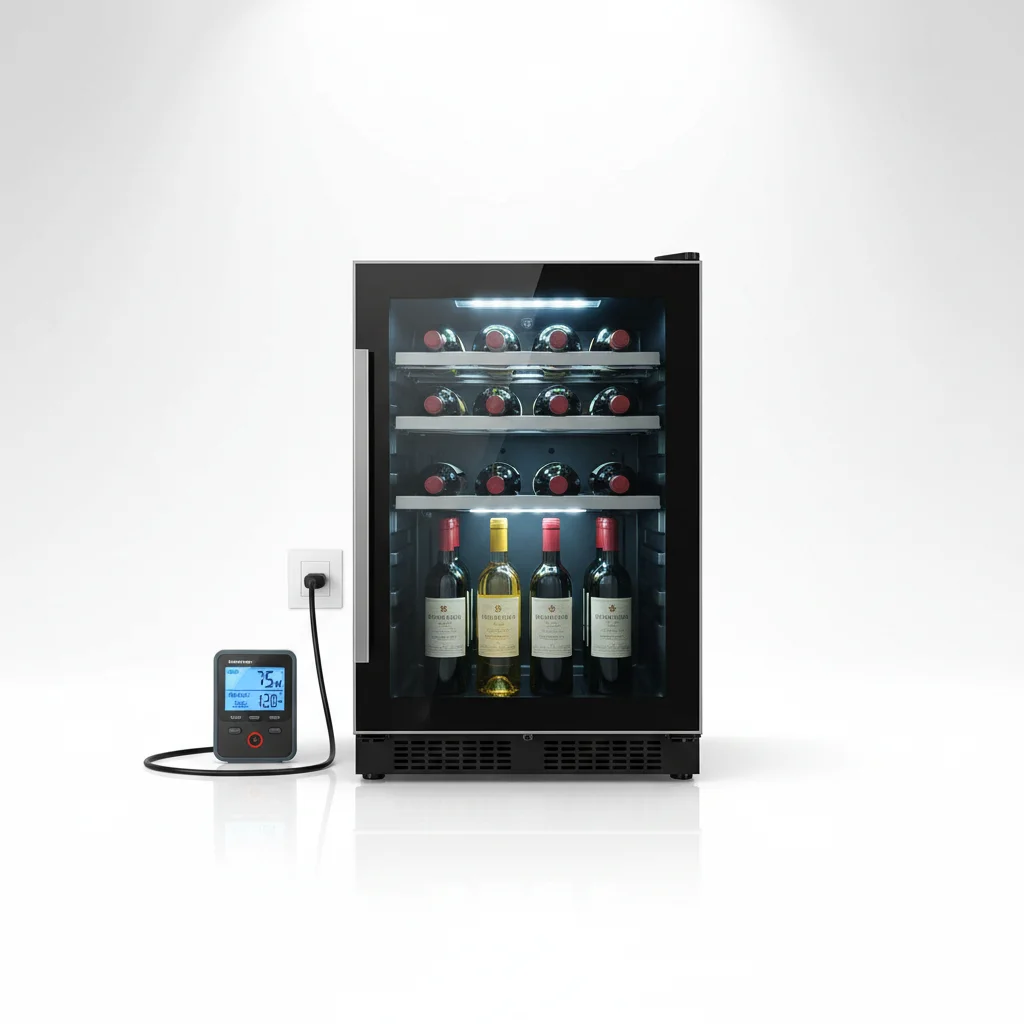
Understanding your wine cooler’s power consumption is crucial for managing electricity costs and ensuring efficient operation. On average, a typical wine cooler uses between 80 to 150 watts when its compressor is actively running. However, the actual energy usage varies significantly based on the unit’s size, insulation, ambient temperature, and the frequency of door openings.
Factors Influencing Wine Cooler Power Consumption
Several key factors dictate how much electricity your wine cooler consumes. The most significant is the compressor’s efficiency; newer models often feature more energy-efficient compressors. The size of the unit also plays a role, with larger coolers requiring more power to maintain temperature. Furthermore, the quality of insulation directly impacts how often the compressor needs to cycle on, as better insulation reduces heat transfer from the outside environment.
Ambient temperature is another critical factor. If your wine cooler is placed in a warm room, its compressor will work harder and run more frequently to maintain the desired internal temperature, leading to higher power consumption. Conversely, a cooler environment allows the unit to operate more efficiently. The frequency of door openings also contributes, as each opening allows warm air to enter, forcing the compressor to work to cool the interior back down.
Calculating Your Wine Cooler’s Daily and Monthly Energy Cost
To estimate your wine cooler’s energy cost, you’ll need to know its wattage and how many hours per day it typically runs. While the compressor might be rated for 100 watts, it doesn’t run continuously. A good rule of thumb is to assume the compressor runs for about 8-12 hours a day, depending on the factors mentioned above. For example, a 100-watt cooler running for 10 hours a day consumes 1000 watt-hours, or 1 kWh, per day. If your electricity rate is $0.15 per kWh, that’s $0.15 per day, or approximately $4.50 per month.
Many wine coolers also have an Energy Star rating, which provides a more accurate estimate of annual energy consumption. Checking the yellow EnergyGuide label on the appliance will give you a precise figure in kWh per year, making it easier to calculate your annual operating cost based on your local electricity rates.
Tips for Reducing Wine Cooler Energy Usage
|
Our Picks for the Best Wine Cooler in 2026
As an Amazon Associate I earn from qualifying purchases.
|
||
| Num | Product | Action |
|---|---|---|
| 1 | Ivation Premium Stainless Steel 8 Bottle Horizontal Thermoelectric Wine Cooler/Chiller Counter Top Red & White Wine Cellar w/Digital Temperature, Freestanding Refrigerator Quiet Operation Fridge |

|
| 2 | BLACK+DECKER BD60026 Wine Cellar with LED Display (8-Bottle Capacity) |
|
| 3 | Cuisinart CWC-800CEN 8-Bottle Private Reserve Wine Cellar |
|
| 4 | BLACK+DECKER Wine Cooler 8 Bottle,Wine Fridge Thermoelectric with Mirrored Front,Freestanding Wine Cooler Refrigerator &LED Display,BD60326 |
|
| 5 | Wine Enthusiast 6-Bottle Countertop Wine Cooler – Compact Mini Fridge for Kitchen or Bedroom with 3 Shelves, Energy-Efficient Cooling, Adjustable Digital Temperature Control |
|
| 6 | Ivation 12 Bottle Compressor Wine Cooler Refrigerator w/Lock, Large Freestanding Wine Cellar Fridge, 41f-64f Digital Temperature Control Glass Door Black |
|
| 7 | Ivation Premium 6 Bottle Horizontal Thermoelectric Wine Cooler/Chiller Counter Top Red & White Wine Cellar w/Digital Temperature, Freestanding Refrigerator Quiet Operation Fridge |
|
| 8 | Wine Enthusiast 32-Bottle Dual Zone MAX Compressor Wine Cooler – Freestanding Mini Fridge with Digital Touchscreen, LED Display, Split Storage for Red & White Wines, Matte Black Refrigerator Home Bar |
|
| 9 | Ivation 12 Bottle Red And White Wine Thermoelectric Wine Cooler/Chiller Counter Top Wine Cellar with Digital Temperature Display, Freestanding Refrigerator Smoked Glass Door Quiet Operation Fridge |
|
| 10 | BLACK+DECKER Wine Fridge 12 Bottles, Thermoelectric Wine Cooler Refrigerator with Mirrored Front, Freestanding 12 Bottle Wine Fridge, BD60336 |
|
Optimizing your wine cooler’s placement and usage habits can significantly reduce its energy consumption. Ensure the cooler is placed in a cool, well-ventilated area, away from direct sunlight or heat sources like ovens and refrigerators. Leave adequate clearance around the unit for proper airflow, especially at the back where the condenser coils are located.
- Maintain a consistent temperature setting; frequent adjustments increase energy use.
- Avoid overfilling the cooler, as this can impede air circulation and make the compressor work harder.
- Regularly clean the condenser coils to ensure efficient heat dissipation.
- Check door seals periodically for any gaps that could allow warm air to leak in.
- Limit how often and how long you open the door to minimize temperature fluctuations.
Comparing Energy Consumption Across Different Wine Cooler Types
The type of wine cooler also influences its power consumption. Thermoelectric wine coolers, while often quieter, are generally less energy-efficient than compressor-based models, especially in warmer environments. Compressor-based units, particularly those with inverter technology, tend to be more efficient for larger capacities and maintaining lower temperatures. Dual-zone wine coolers might consume slightly more power than single-zone models due to the need to maintain two distinct temperature environments, but modern designs are increasingly efficient.
The Impact of Insulation and Design on Efficiency
The quality of insulation is paramount in determining a wine cooler’s energy efficiency. Units with thicker, high-density insulation materials like polyurethane foam are better at preventing heat transfer, meaning the compressor doesn’t have to work as hard or as often. Double-pane or triple-pane glass doors, especially those with UV protection, also play a crucial role in insulation, minimizing heat gain from the surrounding environment and protecting your wine from harmful light exposure. Advanced design features, such as fan-assisted cooling systems, ensure even temperature distribution, which can also contribute to overall efficiency by reducing the compressor’s workload.
Get our weekly buyer guide
Practical specs, not advice. Unsubscribe anytime.

I appreciate the breakdown of factors, especially about ambient temperature. My cooler is in the garage, and it definitely cycles more often in the summer. I wish there was a bit more detail on specific brands or models that are known for being super energy-efficient, beyond just ‘newer models.’ Still, it gave me some good ideas to consider.
I was really worried about my electricity bill after getting a new wine cooler, but this information helped a lot. Knowing that the compressor’s efficiency is a big factor made me double-check the specs on my unit. It’s good to see that my model is on the lower end of the 80 to 150 watts range, so I’m not stressing about it anymore. Definitely a relief to understand the actual usage.
This was super helpful for understanding why my older, larger wine cooler seemed to be running all the time. I hadn’t considered how much the unit’s size impacts power consumption. Now I’m thinking about upgrading to a smaller, more modern one with better insulation to cut down on those energy costs. Good to know what to look for next time.
I always wondered about the actual wattage. It’s great to have a clear idea that a typical cooler uses between 80 to 150 watts. This confirms my suspicion that my frequent door openings probably contribute to higher usage, so I’ll try to be more mindful of that. Thanks for breaking it down so clearly!