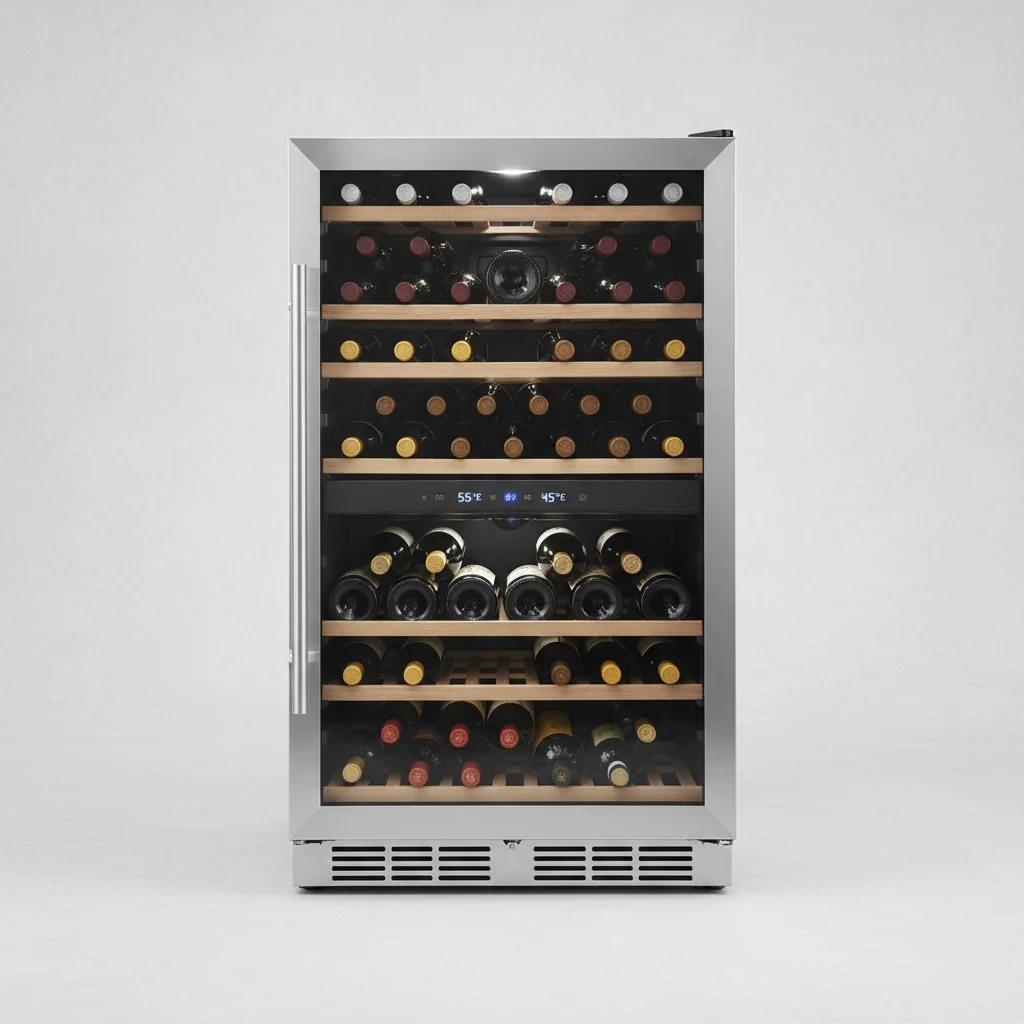
Understanding wine cooler capacity is crucial for any collector, and the answer isn’t always straightforward. Most standard home wine coolers are designed to hold between 12 and 150 bottles, with popular sizes often falling in the 24 to 50-bottle range. This capacity can vary significantly based on the cooler’s dimensions, shelving configuration, and whether it’s designed for standard Bordeaux bottles or a mix of bottle shapes.
Factors Influencing Wine Cooler Capacity
Several key factors dictate how many bottles a wine cooler can truly accommodate. The most obvious is the physical size of the unit; larger external dimensions generally translate to greater internal volume. However, internal design plays an equally important role. The number and spacing of shelves, whether they are fixed or adjustable, and the presence of display shelves or bulk storage areas all impact the practical capacity. For instance, a cooler advertised as 50-bottle capacity might only achieve this with all standard Bordeaux bottles, while wider Burgundy or Champagne bottles will reduce the actual number it can hold.
Standard Bottle Sizes and Their Impact
The type of wine bottle you primarily store will directly affect your cooler’s usable capacity. Standard Bordeaux bottles (750ml) are the most common reference point for manufacturers’ capacity ratings. However, many collectors also store Burgundy, Alsace, or Champagne bottles, which are wider and often require more space. Magnum bottles (1.5L) will take up even more room, often requiring the removal of shelves. When evaluating a cooler, consider the typical bottle shapes in your collection and factor in a potential reduction of 10-20% from the advertised capacity if you store a variety of bottle types.
Types of Wine Cooler Shelving
|
Our Picks for the Best Wine Cooler in 2026
As an Amazon Associate I earn from qualifying purchases.
|
||
| Num | Product | Action |
|---|---|---|
| 1 | Cuisinart CWC-800CEN 8-Bottle Private Reserve Wine Cellar |

|
| 2 | Wine Enthusiast 6-Bottle Countertop Wine Cooler – Compact Mini Fridge for Kitchen or Bedroom with 3 Shelves, Energy-Efficient Cooling, Adjustable Digital Temperature Control |
|
| 3 | BLACK+DECKER BD60026 Wine Cellar with LED Display (8-Bottle Capacity) |
|
| 4 | Ivation Premium 6 Bottle Horizontal Thermoelectric Wine Cooler/Chiller Counter Top Red & White Wine Cellar w/Digital Temperature, Freestanding Refrigerator Quiet Operation Fridge |
|
| 5 | Ivation 12 Bottle Red And White Wine Thermoelectric Wine Cooler/Chiller Counter Top Wine Cellar with Digital Temperature Display, Freestanding Refrigerator Smoked Glass Door Quiet Operation Fridge |
|
| 6 | Ivation 12 Bottle Compressor Wine Cooler Refrigerator w/Lock, Large Freestanding Wine Cellar Fridge, 41f-64f Digital Temperature Control Glass Door Black |
|
| 7 | Wine Enthusiast 32-Bottle Dual Zone MAX Compressor Wine Cooler – Freestanding Mini Fridge with Digital Touchscreen, LED Display, Split Storage for Red & White Wines, Matte Black Refrigerator Home Bar |
|
| 8 | BLACK+DECKER Wine Fridge 12 Bottles, Thermoelectric Wine Cooler Refrigerator with Mirrored Front, Freestanding 12 Bottle Wine Fridge, BD60336 |
|
| 9 | Ivation Premium Stainless Steel 8 Bottle Horizontal Thermoelectric Wine Cooler/Chiller Counter Top Red & White Wine Cellar w/Digital Temperature, Freestanding Refrigerator Quiet Operation Fridge |
|
| 10 | BLACK+DECKER Wine Cooler 8 Bottle,Wine Fridge Thermoelectric with Mirrored Front,Freestanding Wine Cooler Refrigerator &LED Display,BD60326 |
|
The shelving system within a wine cooler is a major determinant of its practical capacity and ease of use. Common types include wire racks, wooden shelves (often beech or oak), and sometimes specialized display shelves. Wooden shelves are generally preferred for their aesthetic appeal and vibration dampening properties, but they can sometimes be thicker, slightly reducing overall capacity compared to thin wire racks. Pull-out or telescopic shelves offer easier access to bottles, especially those at the back, but the mechanisms can also consume a small amount of space. Some coolers feature bulk storage bins at the bottom for stacking multiple bottles.
- Adjustable wooden shelves for versatile storage
- Wire racks for maximum bottle count
- Display shelves for showcasing prized bottles
- Bulk storage areas for stacking multiple bottles
- Sliding shelves for easy access to rear bottles
Choosing the Right Capacity for Your Collection
Selecting the appropriate wine cooler capacity involves assessing your current collection and anticipating future growth. A good rule of thumb is to purchase a cooler with at least 25-50% more capacity than your current needs to allow for expansion. Consider your purchasing habits: do you buy individual bottles, cases, or a mix? If you frequently buy cases, a cooler with dedicated bulk storage or easily removable shelves will be beneficial. For those with a diverse collection of bottle shapes, prioritizing adjustable shelving and slightly underestimating the manufacturer’s stated capacity is a wise approach.
Maximizing Space in Your Wine Cooler
Even with a well-chosen cooler, there are ways to maximize its storage potential. Organizing bottles by size and shape can help utilize every inch. Placing wider bottles on shelves where they fit best, or even removing a shelf for a few magnum bottles, can create more space. Stacking bottles carefully, especially in bulk storage areas, can also increase density. Regularly inventorying your collection helps you understand your storage needs and prevents overfilling, which can hinder air circulation and cooling efficiency.
Get our weekly buyer guide
Practical specs, not advice. Unsubscribe anytime.
