Navigating a compact kitchen often means making tough choices about appliances, especially for wine enthusiasts who dream of preserving their collection perfectly. The good news? You don’t have to sacrifice your passion for prime vintages due to limited space. Narrow wine coolers are ingeniously designed to fit into those seemingly impossible nooks and crannies, transforming underutilized areas into dedicated wine sanctuaries. This guide will walk you through everything you need to know about these slender storage solutions, from understanding their core benefits to discovering the top models that blend seamlessly into any tight kitchen layout.
What is a Wine Cooler? Why Do You Need One?
A wine cooler, often called a wine fridge or wine refrigerator, is a specialized appliance crafted to store wine under optimal conditions, vastly superior to a standard kitchen refrigerator. Unlike a regular fridge that maintains temperatures too cold and humidity too low for wine, a dedicated cooler provides a stable, consistent environment. This precision protects your wine from common enemies: temperature fluctuations that can “cook” or prematurely age wine, dry air that can shrink corks and lead to oxidation, harmful UV light that degrades flavors, and vibrations that disturb sediment and hinder proper aging. Investing in a wine cooler ensures your bottles mature gracefully, preserving their intended taste, aroma, and longevity until you’re ready to uncork them.
Classifying Wine Coolers: Which Option Suits You?
Understanding the different categories of wine coolers helps narrow down the perfect fit for your compact kitchen. Each type offers distinct advantages, especially when space is a premium.
By Size and Capacity
Wine coolers are typically categorized by the number of standard Bordeaux-sized bottles they can hold. For tight kitchen spaces, the focus is generally on smaller capacities:
- Mini Wine Coolers (under 20 bottles): These are perfect for casual drinkers or those with a small, rotating collection. Their compact footprints make them ideal for countertops or very small under-counter niches.
- Small Wine Coolers (20-39 bottles): Offering a bit more capacity, these are suitable for a growing collection or for entertaining. Many narrow models fall into this range, balancing storage with space efficiency.
- Medium Wine Coolers (40-99 bottles): While less common in truly “narrow” formats, some taller, slim models can reach this capacity, catering to more serious collectors who still need a compact design.
|
Our Picks for the Best Wine Cooler in 2026
As an Amazon Associate I earn from qualifying purchases.
|
||
| Num | Product | Action |
|---|---|---|
| 1 | Wine Enthusiast 6-Bottle Countertop Wine Cooler – Compact Mini Fridge for Kitchen or Bedroom with 3 Shelves, Energy-Efficient Cooling, Adjustable Digital Temperature Control |

|
| 2 | Ivation 12 Bottle Red And White Wine Thermoelectric Wine Cooler/Chiller Counter Top Wine Cellar with Digital Temperature Display, Freestanding Refrigerator Smoked Glass Door Quiet Operation Fridge |
|
| 3 | BLACK+DECKER Wine Cooler 8 Bottle,Wine Fridge Thermoelectric with Mirrored Front,Freestanding Wine Cooler Refrigerator &LED Display,BD60326 |
|
| 4 | Ivation Premium 6 Bottle Horizontal Thermoelectric Wine Cooler/Chiller Counter Top Red & White Wine Cellar w/Digital Temperature, Freestanding Refrigerator Quiet Operation Fridge |
|
| 5 | Cuisinart CWC-800CEN 8-Bottle Private Reserve Wine Cellar |
|
| 6 | Ivation 12 Bottle Compressor Wine Cooler Refrigerator w/Lock, Large Freestanding Wine Cellar Fridge, 41f-64f Digital Temperature Control Glass Door Black |
|
| 7 | Ivation Premium Stainless Steel 8 Bottle Horizontal Thermoelectric Wine Cooler/Chiller Counter Top Red & White Wine Cellar w/Digital Temperature, Freestanding Refrigerator Quiet Operation Fridge |
|
| 8 | BLACK+DECKER Wine Fridge 12 Bottles, Thermoelectric Wine Cooler Refrigerator with Mirrored Front, Freestanding 12 Bottle Wine Fridge, BD60336 |
|
| 9 | BLACK+DECKER BD60026 Wine Cellar with LED Display (8-Bottle Capacity) |
|
| 10 | Wine Enthusiast 32-Bottle Dual Zone MAX Compressor Wine Cooler – Freestanding Mini Fridge with Digital Touchscreen, LED Display, Split Storage for Red & White Wines, Matte Black Refrigerator Home Bar |
|
By Cooling Mechanism
The cooling technology inside a wine cooler significantly impacts its performance, noise, and placement flexibility.
- Compressor Wine Coolers: Operating much like a traditional refrigerator, these use a refrigerant and compressor system. They offer powerful cooling, maintain precise temperatures even in fluctuating ambient conditions, and can reach lower temperatures. While typically more efficient for larger capacities, older compressor models can be noisier and heavier. However, modern designs are increasingly quiet and vibration-dampened, making them suitable for built-in applications.
- Thermoelectric Wine Coolers: These utilize the Peltier effect, using an electric current to create a temperature difference. Thermoelectric units are celebrated for their virtually silent, vibration-free operation, making them excellent for living areas or open-plan kitchens where noise is a concern. They are generally more energy-efficient in stable ambient temperatures and tend to be more compact and lighter. However, their cooling power is less robust and can be affected by high room temperatures, making them best suited for smaller collections in temperate environments.
By Installation Type
How a wine cooler is installed dictates its ventilation requirements and aesthetic integration into your kitchen.
- Freestanding Wine Coolers: These units are designed to stand alone, with ventilation typically at the back. They require several inches of clearance around the sides and back, and sometimes on top, to dissipate heat properly. While flexible in placement, they might not be the most space-efficient for truly tight gaps.
- Built-in Wine Coolers (Under-counter): Ideal for seamless integration, these are designed to fit into existing cabinetry or under countertops. They feature front-ventilation, allowing them to be flush-mounted without needing side or rear clearance. This makes them perfect for filling narrow gaps in kitchen designs.
- Integrated Wine Coolers: These take built-in a step further, completely hiding behind a cabinet panel for an invisible, ultra-sleek look that blends entirely with your kitchen aesthetic. This option is typically considered during new kitchen construction or a major renovation.
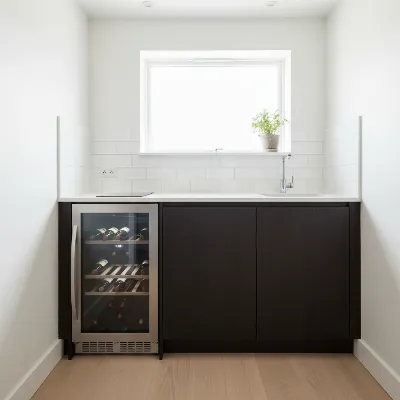 A sleek, narrow wine cooler integrated into a modern, compact kitchen design, showcasing efficient use of space with bottles visible through a glass door.
Narrow Wine Cooler Comparison Table
Finding the right narrow wine cooler means weighing its specifications against your specific needs and available space. Here’s a comparative overview to guide your decision:
| Feature | Mini (e.g., 6-inch width) | Slim (e.g., 12-inch width) | Moderate (e.g., 15-inch width) |
|---|---|---|---|
| Typical Width | 6-8 inches | 12-15 inches | 15-18 inches |
| Bottle Capacity | 6-12 bottles | 12-20 bottles | 20-35 bottles |
| Cooling Type | Thermoelectric, Compressor | Compressor, Thermoelectric | Compressor (mostly) |
| Installation | Freestanding, Built-in | Built-in, Freestanding | Built-in, Freestanding |
| Temperature Zones | Single | Single, Dual (sometimes) | Single, Dual |
| Pros | Extremely space-saving, often very quiet | Good balance of capacity & footprint, versatile installation | Greater capacity, more feature-rich, robust cooling |
| Cons | Very limited capacity, thermoelectric less powerful | Still relatively small capacity | Requires slightly more width, can be pricier |
| Ideal For | Smallest gaps, casual collectors, countertop | Specific under-counter gaps, small to moderate collections | Growing collections, dedicated wine storage zones |
Key Factors When Buying a Narrow Wine Cooler
Choosing the ideal narrow wine cooler requires careful consideration of several elements to ensure it meets your storage needs and integrates perfectly into your kitchen environment.
Capacity and Bottle Count
While the number of bottles a cooler can hold is a primary consideration, remember that published capacities are often based on standard Bordeaux-sized bottles. If your collection includes wider Pinot Noir or Champagne bottles, your actual capacity might be lower. For narrow spaces, prioritize units that maximize vertical storage efficiently, or offer adjustable shelving to accommodate diverse bottle shapes.
Temperature Range and Control
Most wine coolers offer a temperature range between 40°F (4°C) and 65°F (18°C), which is ideal for wine. Decide whether you need a single-zone cooler (perfect for storing one type of wine at a consistent temperature) or a dual-zone cooler (allowing you to store reds and whites at their respective optimal temperatures for serving or aging). Dual-zone coolers are excellent for those who enjoy a variety of wines but typically require a slightly larger footprint.
Noise Level
For kitchen environments, especially open-plan designs, noise can be a significant factor. Thermoelectric coolers are generally quieter due to fewer moving parts, making them a top choice if minimal noise is a priority. Modern compressor models, however, are increasingly designed with low-vibration and quiet operation in mind. Check the decibel (dB) rating if specified, with lower numbers indicating quieter performance.
Energy Efficiency
An energy-efficient wine cooler will save you money on electricity bills over time. Look for Energy Star certifications or compare annual energy consumption ratings. While thermoelectric units can be efficient in stable ambient temperatures, well-designed compressor models can also be very efficient, especially in warmer climates where they don’t have to work as hard to maintain target temperatures.
Design and Style
The aesthetic of your wine cooler should complement your kitchen decor. Common finishes include stainless steel, black, and panel-ready options for full integration. Consider the door style (solid or glass), the type of glass (UV-protected to shield wine from harmful light), and whether the door is reversible to fit your kitchen’s layout. Internal lighting, often soft LED, adds to the visual appeal and helps locate bottles.
Additional Features
Modern wine coolers come with a variety of extra features:
- Locks: Useful for security, especially if children are present or for valuable bottles.
- Carbon Filters: Help maintain fresh air circulation and prevent unwanted odors from affecting the wine.
- Sliding Shelves: Often made of wood, these make it easier to access bottles without disturbing others.
- Humidity Control: Essential for long-term storage, keeping corks from drying out.
Budget
Wine coolers vary widely in price based on capacity, cooling technology, brand, and features. Establish a realistic budget that balances your desired features with what you’re willing to spend. Remember that a higher upfront cost for a quality unit can often translate to better long-term performance and wine preservation.
> “The true value of a narrow wine cooler isn’t just about saving space, it’s about making sophisticated wine preservation accessible to every home, regardless of its footprint.” – Dr. Eleanor Vance, Viticulture Appliance Specialist
Top 5 Narrow Wine Coolers for Tight Kitchen Spaces
When every inch counts in your kitchen, selecting a wine cooler that’s both slim and efficient is paramount. Here are five top-rated narrow wine coolers that excel in design, performance, and functionality for compact environments.
1. Koolatron 7-Bottle Slim 6-Inch Wine Cooler Refrigerator
- Description: An ultra-slim, built-in or freestanding model designed to fit into the narrowest gaps. This cooler is perfect for tiny kitchens or home bars.
- Key Specs:
- Width: 6 inches (approx. 15 cm)
- Capacity: 7 standard Bordeaux bottles
- Cooling Type: Compressor
- Temperature Zones: Single-zone
- Pros: Exceptionally narrow footprint, front-venting for flexible installation, digital touch controls, low-vibration compressor.
- Cons: Very limited capacity, best for small, rotating collections.
2. Kalamera 12-inch 18-Bottle Wine Cooler
- Description: A versatile built-in or freestanding unit that offers a great balance of slim design and respectable capacity, ideal for replacing old trash compactors or fitting into standard 12-inch cabinet openings.
- Key Specs:
- Width: 12 inches (approx. 30.5 cm)
- Capacity: 18 standard Bordeaux bottles
- Cooling Type: Compressor
- Temperature Zones: Single-zone
- Pros: Good capacity for its width, quiet operation, double-layer tempered glass for UV protection, temperature memory function, sliding wood racks.
- Cons: Only single-zone, wider bottles might reduce stated capacity.
3. Colzer Upgrade 15-Inch 32-Bottle Wine Cooler Refrigerator
- Description: For those who need a bit more storage but still prioritize a narrow profile, this 15-inch model provides dual-zone cooling and robust performance suitable for a growing collection.
- Key Specs:
- Width: 15 inches (approx. 38 cm)
- Capacity: 32 standard Bordeaux bottles
- Cooling Type: Compressor
- Temperature Zones: Dual-zone
- Pros: Large capacity for a narrow cooler, dual-zone temperature control for different wine types, sturdy oak shelves, low noise and vibration.
- Cons: Requires a slightly wider space, may be an investment for some budgets.
4. Cuisinart CWC-800CEN 8-Bottle Private Reserve Wine Cellar
- Description: A sleek, compact freestanding or countertop wine cellar that’s ideal for beginners or as a secondary unit. Its elegant design and simple features make it a popular choice.
- Key Specs:
- Width: Approx. 13.75 inches (approx. 35 cm)
- Capacity: 8 standard Bordeaux bottles
- Cooling Type: Thermoelectric
- Temperature Zones: Single-zone
- Pros: Extremely quiet and vibration-free, compact footprint suitable for countertops, digital temperature control, stylish appearance.
- Cons: Limited capacity, thermoelectric cooling is less effective in warm ambient temperatures, only single-zone.
5. Ivation 18-Bottle Compressor Wine Cooler
- Description: This cooler offers a modern aesthetic combined with a powerful compressor system, making it a reliable choice for maintaining optimal wine conditions in a slim profile.
- Key Specs:
- Width: Approx. 13.6 inches (approx. 34.5 cm)
- Capacity: 18 standard Bordeaux bottles
- Cooling Type: Compressor
- Temperature Zones: Single-zone
- Pros: Consistent temperature control, UV-protected double-paned glass door, reinforced rubber gasket for airtight seal, sleek and minimal design.
- Cons: Single-zone only, may be slightly wider than other “ultra-narrow” options.
 A visual display of various narrow wine coolers lined up in a modern showroom setting, highlighting different widths and designs for kitchen integration.
Proper Use and Maintenance for Your Narrow Wine Cooler
To ensure your narrow wine cooler performs optimally and prolongs the life of your precious wines, proper setup, usage, and routine maintenance are crucial.
- Installation and Temperature Adjustment: For built-in models, ensure adequate front ventilation is maintained. For freestanding units, allow sufficient clearance around the sides, back, and top for heat dissipation. Once in place, let the cooler stand for a few hours before plugging it in. Set the desired temperature(s) according to your wine type (e.g., 55°F/13°C for long-term storage, 45-50°F/7-10°C for whites, 60-65°F/15-18°C for reds). Allow 24 hours for the unit to stabilize before loading bottles.
- Arranging Bottles: Place bottles horizontally on the shelves to keep corks moist, preventing them from drying out and allowing air to seep in. Avoid overcrowding shelves, as this can impede air circulation and make it difficult to access bottles. If you have different sized bottles, utilize adjustable shelves or remove a shelf if necessary, keeping in mind this will reduce total capacity.
- Cleaning and Maintenance: Regularly clean the interior with a mild soap and water solution, then wipe dry. For compressor models, periodically clean the condenser coils (usually located at the back or bottom) to ensure efficient operation. Dust and debris can accumulate, making the compressor work harder. Check the door gasket for any signs of wear or damage that could compromise the seal, leading to temperature inconsistencies.
- Important Notes for Longevity: Avoid placing the cooler in direct sunlight or near heat sources like ovens or radiators, as this forces the unit to work harder. Minimize opening the door unnecessarily to maintain stable internal temperatures. If you’re going away for an extended period, ensure the cooler is set to an appropriate, stable temperature.
Conclusion
Finding the perfect narrow wine cooler for a tight kitchen space is not just about accommodating a limited footprint; it’s about embracing a smart storage solution that elevates your wine experience. By understanding the nuances of capacity, cooling mechanisms, and installation types, coupled with a keen eye on design and essential features, you can transform an overlooked corner into a dedicated haven for your cherished collection. Whether you opt for a sleek 6-inch marvel or a dual-zone 15-inch powerhouse, a narrow wine cooler proves that sophisticated wine preservation is truly within reach for every home. Which narrow wine cooler will find its perfect spot in your kitchen, ensuring every bottle is ready for that ideal moment?
Câu Hỏi Thường Gặp
What is the narrowest wine cooler available?
The narrowest wine coolers typically measure around 6 inches wide, designed to fit into extremely tight spaces or be integrated into slim cabinet gaps, often holding 6-7 standard bottles.
Can a narrow wine cooler be installed under a counter?
Yes, many narrow wine coolers are specifically designed as built-in or under-counter models with front-ventilation, allowing them to be installed flush with cabinetry without needing side or rear clearance.
Are thermoelectric narrow wine coolers better than compressor ones for small kitchens?
Thermoelectric narrow wine coolers are often preferred for small kitchens due to their quieter operation and lack of vibration, making them less disruptive in living spaces, though they may be less powerful in warm ambient conditions.
How much space do I need around a freestanding narrow wine cooler?
A freestanding narrow wine cooler generally requires at least 2-3 inches of clearance on the sides and back, and about 3-5 inches on top, to ensure proper ventilation and efficient heat dissipation.
Do narrow wine coolers offer dual temperature zones?
While less common in the ultra-narrow (6-8 inch) sizes, some 12-inch or 15-inch narrow wine coolers do offer dual temperature zones, allowing for optimal storage of both red and white wines simultaneously.
Can I store different bottle sizes in a narrow wine cooler?
Many narrow wine coolers come with adjustable or removable shelves to accommodate various bottle shapes, but it’s crucial to check the internal dimensions and shelf spacing, as wider bottles may reduce the total capacity.
Is UV protection important for a narrow wine cooler in a kitchen?
Yes, UV-protected glass is highly important for any Wine Cooler, even in a kitchen, as it shields your wine from harmful light exposure that can degrade its quality and flavor over time.