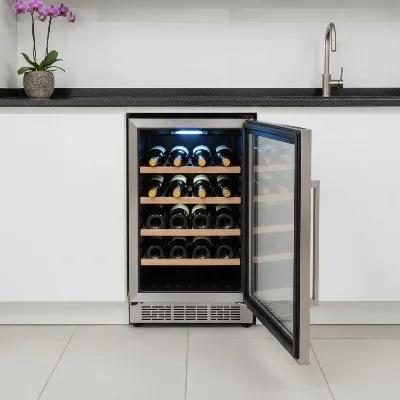
For any wine enthusiast, the ultimate joy comes from savoring a perfectly preserved bottle, its flavors and aromas fully intact. But achieving this ideal state isn’t just about selecting a quality vintage; it hinges critically on how that wine is stored, particularly its temperature. A wine cooler is far more than just a fancy refrigerator; it’s a dedicated environment designed to safeguard your collection from the elements that can prematurely age or spoil your treasured bottles. Understanding and setting the perfect temperature on a wine cooler is the cornerstone of proper wine preservation, ensuring every pour delivers the experience the winemaker intended. This guide will walk you through everything you need to know, from ideal temperature ranges for various wines to the practical steps of operating your cooler’s controls.
Understanding Wine Coolers: Why Temperature Matters for Your Collection
A wine cooler is a specialized appliance crafted to provide an optimal, stable environment for wine storage. Unlike a standard kitchen refrigerator, which operates at much colder temperatures (typically 35-40°F or 1-4°C) and aims for low humidity, wine coolers maintain a consistent, moderate temperature range and stable humidity levels essential for wine longevity. This distinction is vital because extreme temperature fluctuations, excessive cold, or overly dry air can severely harm wine. Rapid temperature swings cause the wine in the bottle to expand and contract, potentially pushing the cork out or allowing oxygen in, leading to oxidation and spoilage. Consistent cool temperatures, typically around 55°F (13°C), are ideal for the long-term aging of all wine types, allowing them to mature gracefully without losing their complex flavors and aromas. Humidity control is also crucial, preventing corks from drying out and shrinking, which would compromise the seal.
Choosing Your Wine Cooler: Impact on Temperature Management
Selecting the right wine cooler is a foundational step in ensuring precise temperature management for your collection. Different types and technologies offer varying degrees of temperature control and stability, making your choice critical.
Size and Capacity: More Than Just Space
|
Our Picks for the Best Wine Cooler in 2026
As an Amazon Associate I earn from qualifying purchases.
|
||
| Num | Product | Action |
|---|---|---|
| 1 | Wine Enthusiast 6-Bottle Countertop Wine Cooler – Compact Mini Fridge for Kitchen or Bedroom with 3 Shelves, Energy-Efficient Cooling, Adjustable Digital Temperature Control |

|
| 2 | Wine Enthusiast 32-Bottle Dual Zone MAX Compressor Wine Cooler – Freestanding Mini Fridge with Digital Touchscreen, LED Display, Split Storage for Red & White Wines, Matte Black Refrigerator Home Bar |
|
| 3 | BLACK+DECKER Wine Cooler 8 Bottle,Wine Fridge Thermoelectric with Mirrored Front,Freestanding Wine Cooler Refrigerator &LED Display,BD60326 |
|
| 4 | Ivation 12 Bottle Red And White Wine Thermoelectric Wine Cooler/Chiller Counter Top Wine Cellar with Digital Temperature Display, Freestanding Refrigerator Smoked Glass Door Quiet Operation Fridge |
|
| 5 | BLACK+DECKER Wine Fridge 12 Bottles, Thermoelectric Wine Cooler Refrigerator with Mirrored Front, Freestanding 12 Bottle Wine Fridge, BD60336 |
|
| 6 | Ivation 12 Bottle Compressor Wine Cooler Refrigerator w/Lock, Large Freestanding Wine Cellar Fridge, 41f-64f Digital Temperature Control Glass Door Black |
|
| 7 | Ivation Premium Stainless Steel 8 Bottle Horizontal Thermoelectric Wine Cooler/Chiller Counter Top Red & White Wine Cellar w/Digital Temperature, Freestanding Refrigerator Quiet Operation Fridge |
|
| 8 | Ivation Premium 6 Bottle Horizontal Thermoelectric Wine Cooler/Chiller Counter Top Red & White Wine Cellar w/Digital Temperature, Freestanding Refrigerator Quiet Operation Fridge |
|
| 9 | Cuisinart CWC-800CEN 8-Bottle Private Reserve Wine Cellar |
|
| 10 | BLACK+DECKER BD60026 Wine Cellar with LED Display (8-Bottle Capacity) |
|
The size and capacity of a wine cooler, ranging from compact 6-bottle units to large cellars holding hundreds, directly influence its cooling efficiency and the stability of its internal temperature. Smaller units might be more susceptible to external temperature changes, while larger, more robust models often feature advanced insulation and more powerful cooling systems to maintain steady conditions. Consider not only your current collection but also your future needs to ensure the cooler can handle the load efficiently without overworking, which can impact temperature consistency.
Cooling Technology: Compressor vs. Thermoelectric for Temperature Stability
The core of any wine cooler is its cooling mechanism, with the two primary types being compressor-based and thermoelectric. Each offers distinct advantages and disadvantages regarding temperature control.
- Compressor Wine Coolers: These operate much like a standard refrigerator, using a refrigerant, compressor, and evaporator coils. They are highly efficient at reaching and maintaining specific temperatures, even in environments with fluctuating ambient temperatures. Compressor models typically offer superior temperature stability and a wider temperature range, making them suitable for most climates and for storing diverse wine collections. However, they can produce some vibration and noise, though many modern designs incorporate anti-vibration technology to mitigate this. They are generally preferred for larger collections and for placement in warmer areas like kitchens or garages.
- Thermoelectric Wine Coolers: Utilizing the Peltier effect, these units transfer heat without refrigerants or mechanical compressors. This results in virtually silent, vibration-free operation, which is excellent for wine preservation. However, thermoelectric coolers are more sensitive to ambient temperatures and perform best in stable, cooler environments (e.g., a cool basement or air-conditioned room). They have limited cooling power and may struggle to maintain consistent temperatures if the external environment is too warm or fluctuates significantly. These are often ideal for smaller collections or for use in quiet living spaces where noise is a concern.
Single vs. Dual Zone: Tailoring Temperature to Your Wines
The choice between a single-zone and a dual-zone wine cooler is paramount when you have both red and white wines, as they have different ideal serving and sometimes even storage temperatures.
- Single-Zone Wine Coolers: These units maintain one consistent temperature throughout the entire cabinet. They are perfect if your collection consists primarily of one type of wine or if you intend to store all your wines at a universal long-term aging temperature (around 55°F / 13°C).
- Dual-Zone Wine Coolers: Featuring two independent compartments, each with its own temperature control, dual-zone coolers allow you to simultaneously store different wine types at their optimal temperatures. For example, you might set one zone to a cooler temperature for white and sparkling wines (e.g., 45-50°F / 7-10°C) and the other to a slightly warmer temperature for red wines (e.g., 55-65°F / 13-18°C). This versatility makes them incredibly popular for enthusiasts with varied collections.
The Ideal Range: What is the Perfect Temperature for Wine Storage and Serving?
Understanding the difference between long-term storage temperatures and optimal serving temperatures is crucial for getting the most out of your wine. While consistency is key for storage, serving temperatures bring out the best in each varietal’s unique characteristics.
The “perfect” storage temperature for all wines for long-term aging is widely considered to be around 55°F (13°C). This temperature slows down the aging process, allowing complex flavors to develop without premature oxidation. However, serving temperatures vary significantly to highlight the best qualities of different wines. Storing all wines at 55°F (13°C) and then chilling or warming them to their ideal serving temperature just before consumption is a common practice for serious collectors.
Here’s a general guide for storage and serving temperatures:
| Wine Type | Ideal Storage Temperature (Approx.) | Ideal Serving Temperature (Approx.) |
|---|---|---|
| Red Wines | 55°F (13°C) | 60-65°F (15-18°C) |
| Full-Bodied Reds | 55-60°F (13-16°C) | 62-68°F (17-20°C) |
| Lighter Reds | 50-55°F (10-13°C) | 55-60°F (13-16°C) |
| White Wines | 55°F (13°C) | 45-55°F (7-13°C) |
| Full-Bodied Whites | 55°F (13°C) | 50-55°F (10-13°C) |
| Light & Dry Whites | 55°F (13°C) | 45-50°F (7-10°C) |
| Rosé Wines | 55°F (13°C) | 45-50°F (7-10°C) |
| Sparkling Wines/Champagne | 55°F (13°C) | 40-45°F (5-7°C) |
| Dessert & Fortified Wines | 55°F (13°C) | 50-60°F (10-16°C) |
> “The greatest misconception is that ‘room temperature’ red wine is ideal. In reality, modern indoor temperatures are often too warm. Aim for a cool cellar temperature for reds, typically between 60-65°F, to truly appreciate their nuances.” – Master Sommelier Jane Doe, Wine Education Director
How to Set the Perfect Temperature on Your Wine Cooler: A Step-by-Step Guide
Setting the temperature on your wine cooler is typically a straightforward process, though it varies slightly between single-zone and dual-zone models. The key is patience, as it can take several hours for the internal temperature to stabilize after an adjustment.
Setting Single-Zone Coolers
For a single-zone wine cooler, you will set one temperature for the entire unit.
- Determine Your Primary Wine Type: If you mostly store reds for aging, set it to the universal 55°F (13°C). If you primarily store whites for immediate consumption, you might opt for a cooler 45-50°F (7-10°C), understanding that reds stored here will be too cold.
- Locate the Control Panel: Most single-zone coolers have a digital display and simple up/down arrow buttons on the front or inside the unit.
- Adjust the Temperature: Press the up or down arrow buttons to cycle through the temperature settings until you reach your desired value. The display will usually flash while you are making the adjustment.
- Allow Time to Stabilize: Once set, the display will stop flashing, indicating the new target temperature. Give the cooler ample time (several hours, sometimes up to 24) to reach and stabilize at this new temperature before adding wines or making further adjustments.
Mastering Dual-Zone Settings
Dual-zone wine coolers offer greater flexibility by allowing two distinct temperature environments.
- Identify Zones: Typically, dual-zone coolers have clearly marked “Upper Zone” and “Lower Zone” controls on the digital panel. One zone is usually designed for colder temperatures (whites/sparkling), and the other for warmer (reds). For example, many units recommend the upper zone for white wines and the lower zone for red wines, or vice versa depending on the model.
- Set Each Zone Individually: Use the dedicated up/down arrows for each zone to set its desired temperature.
- White Wine Zone: Aim for 45-50°F (7-10°C) for ready-to-serve whites and sparkling wines.
- Red Wine Zone: Aim for 55-65°F (13-18°C) for ready-to-serve reds or for long-term storage of all wines.
- Temperature Differential: Many dual-zone units require a minimum temperature difference between zones (e.g., 8°F or 4°C) for optimal performance. Consult your cooler’s manual for specific recommendations. For instance, you cannot usually set both zones to the exact same temperature or have the “cold” zone warmer than the “warm” zone.
- Monitor and Stabilize: As with single-zone coolers, give both zones time to reach and maintain their set temperatures before filling.
Understanding Your Control Panel
Modern wine coolers feature intuitive digital control panels. Common functions include:
- Temperature Up/Down Arrows: Used to increase or decrease the temperature setting for the selected zone.
- Zone Select Button: On dual-zone models, this button allows you to toggle between the upper and lower zone controls.
- Fahrenheit/Celsius Toggle: Often a dedicated button or a long-press function on another button (e.g., the light button) to switch the display between °F and °C.
- Lock/Unlock Feature: Many panels include a lock function to prevent accidental temperature changes. You might need to press and hold a specific button (like “Zone Select” or a padlock icon) for a few seconds to unlock it before making adjustments.
- Light Button: To control the interior light.
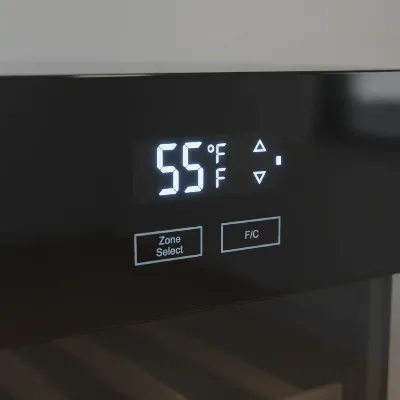 Digital display of a wine cooler showing temperature settings and controls
Buying a Wine Cooler for Optimal Temperature Control (Buying Guide)
When purchasing a wine cooler, several features directly influence its ability to maintain the perfect temperature and protect your wine.
Temperature Range and Consistency
Look for a cooler that offers a precise temperature range, ideally between 40°F and 65°F (5°C and 18°C), and, most importantly, boasts excellent temperature stability. Compressor models generally provide superior consistency, especially in fluctuating ambient conditions. Reviews often highlight models known for their ability to hold a set temperature without significant swings. Consider models with advanced insulation and UV-protected glass doors, which further aid in thermal stability.
Humidity Control
While the primary focus is temperature, humidity is a crucial partner in wine preservation. A stable humidity level, ideally between 50-70%, prevents corks from drying out and allowing oxygen into the bottle. Some high-end wine coolers offer active humidity control, while others rely on good insulation and the cooler’s inherent design to maintain appropriate levels.
Location and Ambient Temperature
Where you plan to place your wine cooler should heavily influence your choice. If it’s in a hot garage or a sunny room, a robust compressor model is almost certainly necessary. For a cool, stable basement or a quiet living area, a thermoelectric unit might suffice for smaller collections. Built-in models require specific ventilation clearances, which can impact cooling efficiency if not properly installed.
Additional Considerations
- Noise Level: Compressor units are generally louder than thermoelectric, but many manufacturers offer low-vibration, quiet compressor models.
- Energy Efficiency: Look for Energy Star ratings to ensure your cooler operates efficiently, saving on electricity costs.
- Design and Capacity: Choose a design that complements your space and a capacity that meets your current and projected collection size without being overfilled, as proper airflow is vital for consistent temperatures.
- Security Features: Locks can protect your valuable collection.
- Lighting: LED lighting is preferred as it emits less heat and UV radiation than incandescent bulbs.
Maximizing Performance: Tips for Using and Maintaining Your Wine Cooler
Once you’ve set the perfect temperature on your wine cooler, ongoing care and mindful use will ensure it continues to perform optimally and protect your wine collection for years to come.
Proper Placement for Temperature Efficiency
Ensure your wine cooler is placed in a location away from direct sunlight, heat-generating appliances (like ovens or dishwashers), and heating vents. Good ventilation around the unit is also critical, especially for built-in models, to allow the cooling system to dissipate heat effectively. Restricted airflow forces the cooler to work harder, leading to temperature fluctuations and reduced lifespan.
Loading and Airflow
Avoid overfilling your wine cooler. Proper air circulation around and between bottles is essential for maintaining an even temperature throughout the unit. Leave a small gap between bottles and ensure the internal fan (if present) is not obstructed. Arranging bottles correctly also prevents unnecessary temperature swings from frequent door openings to search for a specific wine.
Regular Maintenance for Consistent Cooling
- Clean the Coils: For compressor models, periodically clean the condenser coils (usually located at the back or bottom of the unit). Dust and debris can accumulate, reducing efficiency and leading to warmer internal temperatures.
- Check Door Seals: Inspect the door gasket regularly for cracks or gaps. A compromised seal allows warm air to enter, forcing the compressor to run more frequently and affecting temperature stability. Clean the seals with mild soap and water to keep them pliable.
- Defrosting: Some models require manual defrosting to prevent ice buildup, which can hinder cooling. Follow your manufacturer’s guidelines.
- Keep it Closed: Minimize how often and how long you open the cooler door to prevent warm air from entering and disrupting the stable internal temperature.
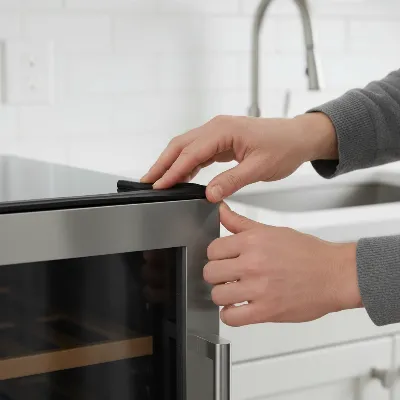 Person checking the seal of a wine cooler door for maintenance
By adhering to these usage and maintenance tips, you can ensure your wine cooler consistently provides the perfect temperature environment, safeguarding your cherished wines and enhancing your enjoyment of every bottle.
Conclusion
Mastering How To Set The Perfect Temperature On A Wine Cooler is fundamental to preserving the quality and integrity of your cherished wine collection. From understanding the nuanced ideal storage and serving temperatures for various types of wine to navigating the controls of single or dual-zone units, precise temperature management is key. By selecting the right cooler for your needs, considering its cooling technology and placement, and diligently maintaining it, you create an optimal environment where your wines can age gracefully and be enjoyed at their peak. What will be the first perfectly chilled bottle you uncork from your impeccably maintained wine cooler?
Câu Hỏi Thường Gặp
What is the best all-around storage temperature for a mixed wine collection?
The universally recommended long-term storage temperature for all types of wine, regardless of red, white, or sparkling, is approximately 55°F (13°C). This temperature effectively slows down the aging process, allowing wines to mature gracefully while preserving their delicate flavors and aromas without premature oxidation.
How long does it take for a wine cooler to reach its set temperature?
After initial setup or a significant temperature adjustment, a Wine Cooler typically takes several hours to stabilize. Depending on the ambient room temperature, the size of the cooler, and the magnitude of the temperature change, it can sometimes take up to 24 hours to reach and consistently maintain the new target temperature.
Can I store red and white wines together in a single-zone cooler?
Yes, you can store both red and white wines in a single-zone cooler, especially if your primary goal is long-term aging. The universal storage temperature of 55°F (13°C) is suitable for both. However, you’ll need to chill white wines further or allow red wines to warm slightly to reach their ideal serving temperatures after removing them from the cooler.
Is humidity important in a wine cooler?
Absolutely. Stable humidity levels, ideally between 50-70%, are crucial for wine preservation. Too little humidity can cause corks to dry out, shrink, and allow air to seep into the bottle, leading to oxidation. Too much humidity can foster mold growth on labels and corks.
Why does my wine cooler temperature fluctuate?
Temperature fluctuations can stem from several factors, including placing the cooler near heat sources or in a room with wide ambient temperature swings, poor door seals allowing warm air in, or an overloaded unit hindering air circulation. Compressor issues or condenser coil dust buildup can also reduce cooling efficiency.